Suzhou was established by He Lu of the Wu Kingdom in 514 BC and , like Hangzhou ( with which it is commonly linked in the name Suhang), its history has been characterized by waterways, prosperity, high-culture and the silk trade. The two cities are also coupled by the ancient proverb: in heaven there is paradise, on earth Hangzhou and Suzhou: Today , this elegant legacy is combined with high technology industry and architectural modernity.
This is tour can be tailor made based on your requirements. My suggestion tour itinerary would be as follows:

Route : Boarding-Tiger Hill-Boat tour ( pass through oldest river in suzhou)- to Tongli ( Chinese style Venice)
Price Details:
We will take train first to suzhou , After we will driave with car travel in this city and Tongli.
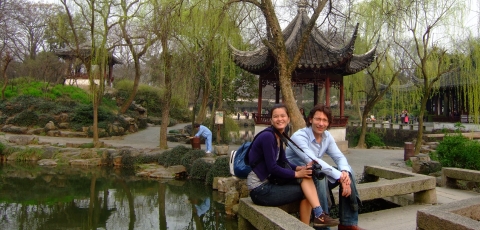
Humble Administrator’s Garden: Covering 51,950 sq.m,the Humble Administrator’s Garden is the largest of all classical gardens in Suzhou . It is centered upon the broad expanse of a lake, making up about one fifth of the total area. With well spaced buildings, the garden landscape and water scape are simple, extensive and natural, possessing the traditional appearances of the Ming Dynasty. It is divided into three parts; the eastern, middle and the western parts. The house lies in the south of the garden.
Lion Forest Garden: Compactly yet harmoniously spaced,the Lion Grove Garden has a prominent part for series of man-made mountains with various buildings around the lake ,and an artificial waterfall and cliffs at the edge of the lake on the west. Remains of the 14th century man-made mountains,covering 1,152 sq.m.and being the largest of all at Suzhou,can be still seen today.Noted for its labyrinthine mountains with winding pathways and caverns,old pines and cypress trees,awesome peaks and jogged rocks of grotesque shapes resembling dancing lions with striking and unusral poses,it possesses with pride the true delights of mountain and forest scenery in limited space with a flavor of Zen Buddhism.
The Lingering Garden:The Lingering Garden was listed from the first as cultural relics of national importance in 1961. With an area of 23,310 sq.m.it is celebrated for its artistic way of dealing with the spaces between various kinds of architectural form.Buildings make up one third of the total area of the garden,the hall of which being the most remarkable in Suzhou . The garden is separated into the middle ,eastern,northern and western parts. The ancestral temple and the house lie to the south of the garden.

The Master-of-Nets Garden:The Master-of-Nets Garden covers 5,400 sq.m. and is divided into two parts: the eastern house and the western garden.Half enclosed by a screen wall with a row of iron rings for tethering horses,and two alleyway side entrances,the front door faces south,having a pair of var. Pendular in front ,and hairpin-like door ornaments above ,and two huge blocks of stone carved in the shape of drums kept fast with the hands,placed one by its left side and another by its right side.This type of front door showing owner’s rank at the court has become very rare now. On a north-south axis there are four successive buildings separated by garden courts,namely the front door hall, the sedan-chair hall, the grand reception hall and the two-storeyed tower.Constructed in accordance with the strict regulations of feudalism, they are magnificent buildings with extraordinary furnishing and interior decoration. In front of the grand reception hall is a door with richly carved earthen ornamentation.The two-storeyed tower at rear is the place where the family used to stay,and the hall in front is chiefly for reception,public celebrations and ceremonial observances.Every hall has a door or walk-way leading to the garden.It is a typical example of combining living quarters with a landscape garden in Suzhou.
Beisi Pagoda or North Temple Pagoda: Covering about 40 mu (= 0.0667 hectares), the North Temple Pagoda was originally the Tongxuan Temple during the reign of Chiwu of the Eastern Wu in the Three States built by Sun Quan, the Emperor of Wu, for his wet nurse. It was granted as the “Epoch-making Temple” in the Tang Dynasty and began to be called the “ Reciprocation Temple ” at the end of the Five Dynasties. So far it has a history of more than 1,700 years.
The Reciprocation Temple Pagoda, or the North Temple Pagoda, is a provincial preservation unit of historical and c
ultural relics and is popularly praised as the “ Number One Pagoda in South of the Yangtse River ” . Standing far apart facing the Tiger Hill Pagoda, the North Temple Pagoda is also a famous old pagoda and an important symbol of Suzhou .
Tong li: Tongli is rich in culture. In the long run of its history, it was once famed for its achievements in the imperial examinations and has produced famous cofucianists and notables. About 40 stone tablets of different periods have been well preserved and a quite number of its steets and alleys are name

Being an ancient township, Tong Li borders on Tongli Lake on the east, Nanxin Lake on the south, adjoins Pangshan Lake on the west, Jiuli Lake on the north and Wusong Jiang River on the northwest. The town proper is divided by the streams into 7 islets interlaced with the surrounding water area, forming typical water county of the south.
With a network of lakes and waterways, Tongli has not suffered from war since it was inaccessible in the old times. Therefore more ancient buildings are preserved, among which we can still enjoy the following scenic spots “ the Moon Viewing at the East Stream”, “the Misty South Market at Dawn”, “the Night Crossing at the West ferry”, “the Spring Sight in the North Hill”, “the Fishermen’s Flute in the Water Village” and “the Misty Bamboo of the Chan Hill”. The traditional houses densely settle on the sides of the fine banks piled by Jinshan Stone, and winding alleys and streets paved with pebble stones still keep the ancient appearance. There are 24 bridges at the intersection of waterways. The Siben Bridge built in the Southern Song dynasty is simple and archaic. The Fu’guan Bridge built in the Yuan dynasty is grandiose.

History of Suzhou
Renowned for its numerous gardens and canals, Suzhou is frequently mislabeled as the “Venice of the East”. Its size and trading volumes though once significant nonetheless do not warrant such a grandiose comparison. Rather, it is best to think of Suzhou as the most distinguished of a multitude of canal towns, dotted around the Yangzi delta.
Suzhou’s history dates back to the early seventh century BC at which time the semi-mythical ruler, He Lu, of the Kingdom of Wu is said to have founded the city. With the completion of the Grand Canal during the Sui dynasty (581-618 AD), Suzhou became a thriving commercial district as items such as silk were transported along the bustling waterways. Marco Polo recorded that its populace was comprised of “prudent merchants, and, as already observed, skilful in all the arts. They have also many persons learned in natural science, good physicians, and able philosophers.”

During the Ming dynasty (1368 – 1644) with the increased concentration of silk manufacture here, Suzhou became an ever more fashionable cultural center. Thus by 1794, one of the members of Lord Macartney’s ill-fated embassy to China described the town as having “(ruling) Chinese taste in matters of fashion and speech, and is the meeting place of the richest pleasure-seekers and gentlemen of leisure in China.”
The city’s good fortune ran out during the 1860’s due to its occupation in the Taiping rebellion and then again in World War II by the Japanese. Today however, Suzhou is regaining its reputation for leisure as its visitors are afforded the rare opportunity to wander through the ancient gardens and homes of aristocrats, scholars and merchants. It is said that at one time, there were more than two hundred gardens in Suzhou. While not all of these still exist, some of the more famous such as those of the Humble Administrator and the Master of the Nets have been restored to their former beauty.
More recently, the city has been undergoing a new transformation. A Singaporean consortium, with the contribution of I.M. Pei, a Suzhou native, has helped to revive Suzhou’s original architectural facade. Once more, Suzhou offers a parade of traditional white buildings and cobble-stoned walkways, lined with trees and flowering plants.

Recent Comments